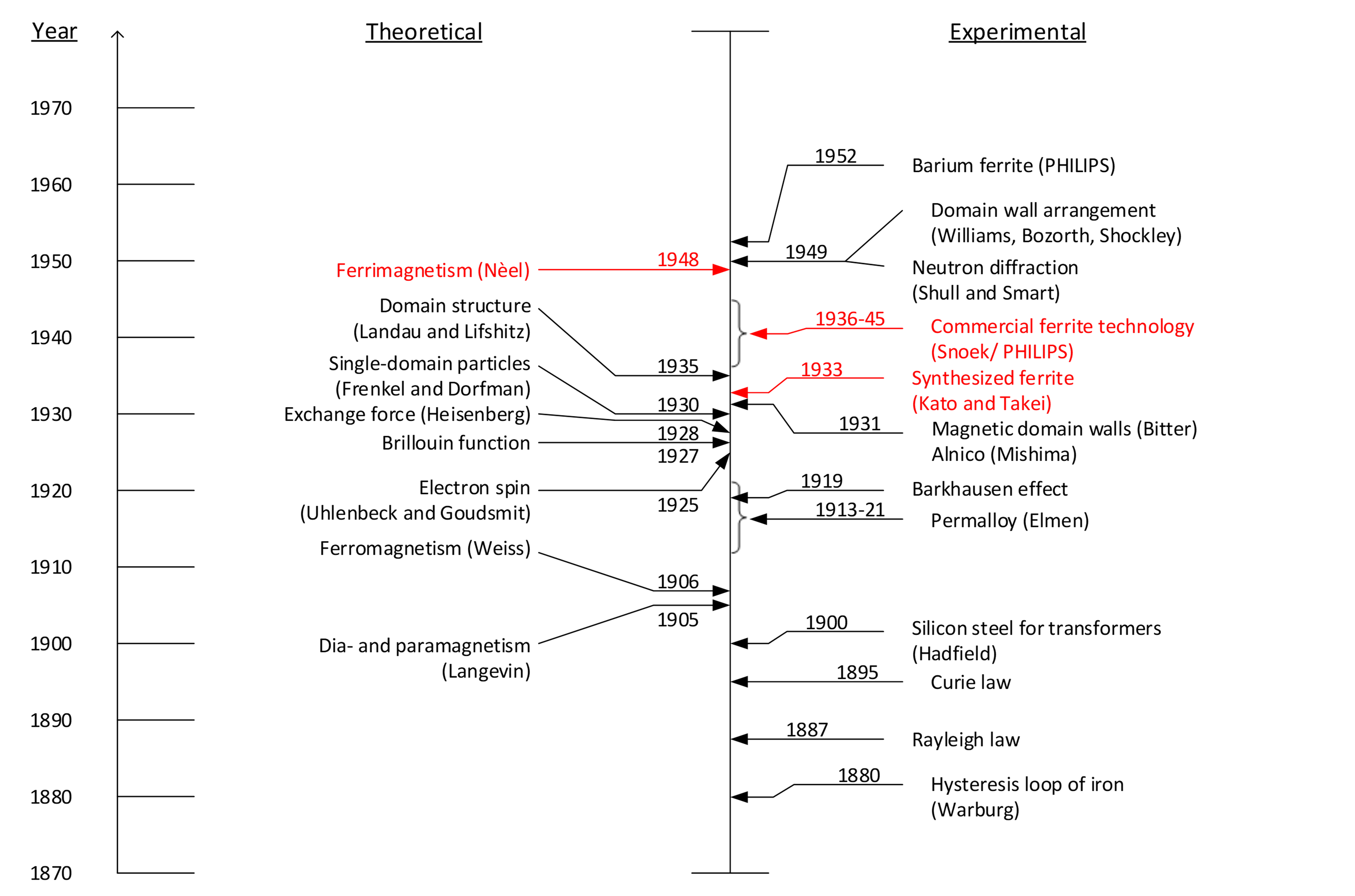
Turning points of soft ferrites
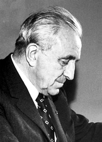
Dr. Louis Néel
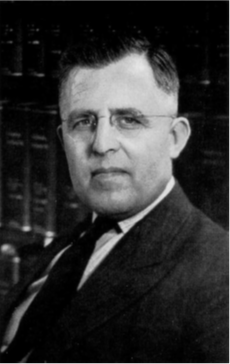
Dr. J. L. Snoek
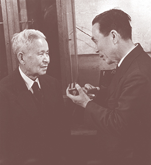
Dr. Yogoro Kato (left) and
Dr. Takeshi Takei (right) Introduction to ferritesFerrites are categorized as electroceramics with ferrimagnetic properties.
Ferrimagnetism occurs due to super exchange interactions between the electrons of metal and oxygen ions in ferrites. The less parallel spin alignment in ferrites results in lower magnetization compared to ferromagnetic metals, where spin moments align parallel to one another. Due to the intrinsic interactions between oxygen and metal ions at the atomic level, ferrites possess higher resistivity than ferromagnetic metals. This high resistivity makes ferrites exceptionally useful and technologically valuable for a wide range of high-frequency applications. A spinal lattice forms the crystal structure of these ferrites, following the chemical formula MeFe2O4 where Me represents a divalent metal ion (e.g. Fe2+, Ni2+, Mn2+, Mg2+, Co2+, Zn2+, Cu2+ etc.). Nowadays, the most popular commercial ferrite compounds are MnZnFe2O4 and NiZnFe2O4, which differ primarily in their resistivity. Data sheets illustrate these material properties using toroidal cores for each specific material grade.
The spinel lattice:
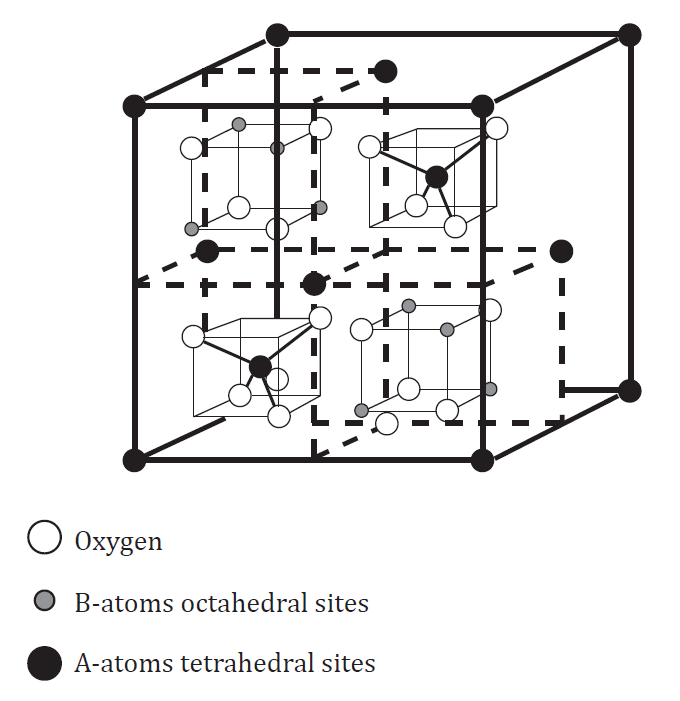
The following figure shows a unit cell of the spinel lattice and the sites of various ions. The spinel structure consists of several interlaced face-centered cubic lattices. These sub-lattices play an important role in ferrite magnetism. In a unit cell of spinel crystal structure of ferrites, one metal ion (e.g., Fe2+, Ni2+, Mn2+ etc.) is on tetrahedral (A) site and two ions (e.g., Fe3+, Zn2+) occupy the octahedral (B) sites. In a "normal" spinel, the divalent Me ion would occupy the A site, while the trivalent Fe ions would occupy the B site. Conversely, in an ‘inverse’ spinel, the divalent Me ion occupies one B site while the trivalent Fe ions occupy the remaining B site and the A site. Many commercially important ferrites, such as MnZn-ferrites and NiZn-ferrites, are ‘inverse’ spinels. In ferrite manufacturing, both composition and process conditions are crucial to get the required properties.
 Ferrimagnetism
Louis Néel proposed the term "ferrimagnetism" to describe the magnetism found in ferrites. At the molecular level, ferrites exhibit ferrimagnetism because of "superexchange" -electronic interactions between metal and oxygen ions that create net magnetic moments. In a bulk ferrite, the crystallite is normally divided into a number of magnetic domains (Weiss domains) with various spin orientations. This variety ensures that very little external field arises from the internal magnetization in the crystallite of ferrite polycrystalline structures; consequently, the demagnetizing fields remain small. If a magnetic field is applied to the ferrite bulk along its magnetic path, irreversible movements of the domain walls occur. Due to these irreversible movements, the magnetization always lag behind the magnetizing field and traces an open loop. This phenomenon is known as magnetic hysteresis, and the loop is called a hysteresis loop.
References
|